The Myth That Every Courtroom Is Open to Every Observer
The myth that every courtroom is open to every observer confuses public hearings with unrestricted entry. Learn what can limit access and how to check.
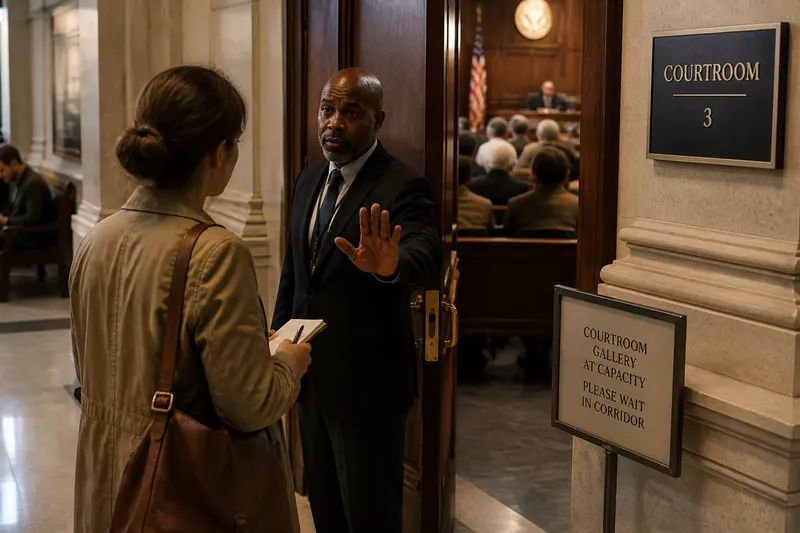
A visitor reaches the courtroom door just as an usher turns someone away. The hearing appears on the daily list, but the gallery is full. The myth that every courtroom is open to every observer confuses a general principle with an unconditional invitation.
Public access makes court proceedings visible to people beyond the parties involved. It does not mean that every hearing, document or moment is open to everyone. The reason for a limit matters: a full room, a changed timetable and a legal restriction are different things, even if each leaves a visitor in the corridor.
A public listing is not a seat reservation
A court listing tells visitors what is scheduled, subject to change. It does not promise that a hearing will begin as planned or that the public gallery will have space. Proceedings may be delayed, moved or dealt with differently from what the listing suggests.
Nor does access to the courthouse amount to access to every room. Security arrangements govern entry to the building; courtroom staff manage the hearing and the space around it. Each answers a different question.
Imagine Jo, an invented visitor, sees a case listed at the fictional Northgate Court and arrives with a notebook. The listing shows a courtroom, but the gallery is full. Jo asks the usher whether the hearing is open and whether visitors may wait for a seat. The usher says the hearing is open, but entry depends on space becoming available. Jo waits in the public corridor rather than trying another entrance. The observable result is clear: the barrier is capacity, not an order closing the hearing.
Capacity and legal restrictions are different limits
A full gallery is a practical obstacle. It does not, by itself, mean the hearing has been closed to the public. Staff may ask visitors to wait outside because standing in a doorway or blocking movement is not a workable alternative.
A legal restriction is different. A judge may direct that a particular part of a hearing take place without the public, or rules may limit attendance for a category of proceeding. The grounds and powers vary by jurisdiction and case. A visitor should follow the direction and avoid guessing about protected information.
Some restrictions concern only a segment or specific material; others may apply more broadly. An announcement that the public must leave does not, on its own, explain the full legal basis or show that the entire case is private. The appropriate distinction is between the general principle of open justice and the rules governing the hearing at hand.
Access does not include every document or recording
Listening to a public hearing is not the same as inspecting the case file. Documents, transcripts and recordings may be governed by separate rules and procedures. A case number or a seat in the gallery does not automatically provide access to them.
Likewise, permission to attend does not automatically permit photography, audio recording or broadcasting. Court rules and local directions determine what is allowed. Visitors should check official guidance or ask court staff before recording or publishing material.
What should a visitor ask when access is unclear?
Does a closed door mean the whole hearing is private?
Not necessarily. The gallery may be full, the hearing may have moved, or a restriction may apply only to a particular part. Ask staff what can be explained about the reason and scope, without seeking protected details.
What if the hearing changes room or time?
Check the court’s current listing or information desk, then follow directions at the building. A news report can help identify a case, but it may not reflect the latest arrangements.
Can a visitor take notes or record the hearing?
Quiet note-taking and recording are not interchangeable. Check the court’s guidance and any directions from the judge before using a camera, phone recorder or livestreaming service.
Can the public read the case file?
Document access depends on the record and the applicable procedure. Ask the court about the proper route for requesting a transcript or document; attendance alone does not settle the question.
Prepare for the visit by checking specific details
A short check before setting out can clarify what is known and what remains uncertain. For each observation, decide what to do next rather than treating one source as an answer to every question.
- Listing: If the official listing shows the court and hearing, use it to identify where to ask for directions; if it is missing or unclear, contact the court rather than relying on an old report.
- Time or room: If the listing and building notice agree, follow the stated arrangement; if they differ, ask the information desk which is current.
- Visitor rules: If the guidance explains entry, bags and phones, follow it; if it leaves a point unresolved, ask staff before bringing an item into the courtroom.
- Available seating: If staff say the gallery has room, follow their instructions; if it is full, wait where directed or ask whether another public session is available.
- Restriction announcement: If staff say access is limited, comply and ask whether the direction covers the whole hearing or only the current part; if they cannot disclose more, do not press for confidential details.
- Recording rules: If official guidance expressly permits a form of recording, follow its conditions; if permission is absent or unclear, do not record and ask the court.
- Documents: If the court identifies a procedure for a transcript or record, use that route; if no procedure is stated, ask where to find it rather than assuming the document is public.
These checks are general courtesies, not advice on an individual case. Questions that turn on a particular proceeding or legal right may require guidance from a qualified legal professional.
Open justice depends on knowing where the boundary lies
In the invented Northgate visit, Jo sees the listing, asks about a full gallery and waits for staff to explain the available arrangement. If a later part of the hearing is restricted, Jo leaves when directed and does not try to infer its contents from corridor conversation. The outcome is limited but intelligible: Jo observes what is open and recognises that other material is outside the permitted view.
The myth that every courtroom is open to every observer mistakes public scrutiny for unrestricted access. A visitor may be able to observe a hearing while still facing limits on seating, conduct, particular proceedings and records. Those boundaries depend on the applicable law and the court’s directions, not simply on whether a courthouse door is open.
For anyone planning a visit, the useful habit is to check the current listing, ask staff a precise question and respect a stated restriction. If the point concerns a specific legal entitlement rather than the practical arrangements for observing, a qualified legal professional is the appropriate person to consult.