Why Courts Have Clerks, Not Just Judges
Why courts have clerks, not just judges: see how official records and routine procedure support a court without giving clerks the judge’s role.
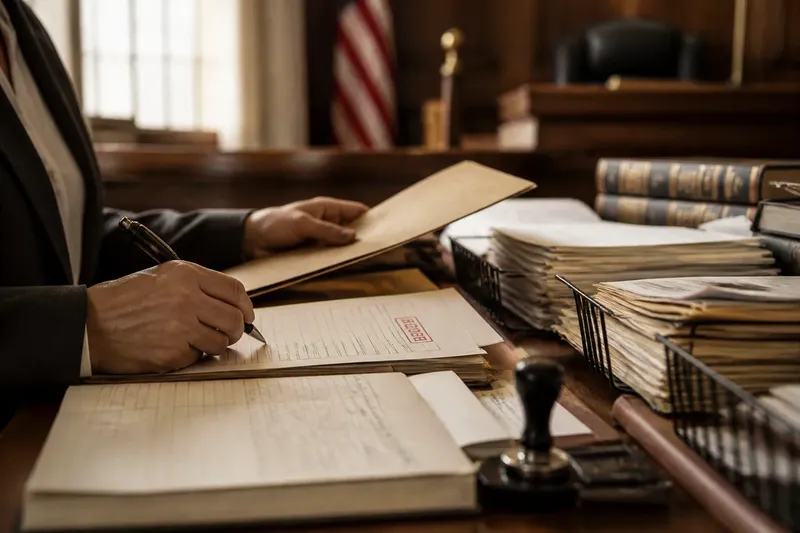
A clerk checks the day’s list, finds a file and marks a document as received before the judge takes the bench. That ordinary division of labour helps explain why courts have clerks, not just judges: a court must both decide disputes and keep an orderly account of its proceedings.
Court clerks serve the court’s ongoing work
A hearing ends, but the court’s work does not. Filings need to be received, orders recorded and documents kept so the parties and the court can identify what happened later. Clerical work gives those tasks an assigned place within the institution.
The specific duties vary by jurisdiction, court and period. In some settings, a clerk’s office handles filings, registers and routine notices; elsewhere, similar responsibilities may belong to staff with another title. The historical record is not one uniform story, so it is safer to describe the recurring function than to claim a single origin for the role.
Records turn a hearing into an official account
A court record distinguishes the official course of a matter from private notes or recollections. It may contain filed documents, entries about hearings and orders made by the court. Which materials are included, and how they are preserved, depends on the system’s rules.
This record can help identify what remains to be done and what has already been decided. It also gives later stages of a case an account to consult, where the relevant rules provide for review. A record is not a perfect substitute for everything said or understood in a courtroom; it is the formal account the system recognises.
Clerical work is distinct from judging
A judge exercises judicial authority by hearing matters and making decisions. A clerk’s office carries out assigned administrative work, such as receiving documents or recording an order after it has been made. Recording a decision does not make the clerk its author.
Some routine tasks require staff to apply procedural rules, and the boundary can depend on local law and court practice. The useful distinction is between administering the court’s process and deciding the dispute. Where a particular action’s legal effect is unclear, local rules or a qualified legal professional are the appropriate sources.
Why courts have clerks, not just judges becomes clear in routine tasks
The phrase points to a division of responsibility, not to a claim that every court uses the same staffing model. A judge may focus on a matter before the court while the clerk’s office handles the continuing sequence of filings, notices and entries. This can make the court’s work easier to follow without shifting judicial authority to administrative staff.
Say a small court receives a new motion while a hearing is under way. The clerk records its arrival and routes it under the court’s procedures; the judge later decides what to do with it. The observable result is a dated entry and a pending decision, not a ruling made by the clerk. This invented situation illustrates the distinction rather than describing a historical event.
Clerk titles do not identify one universal job
“Clerk” can refer to different roles. A court clerk may manage records or filings, while a judicial law clerk may assist a judge with legal work. Shared wording does not mean shared duties.
To understand a particular title, check the court’s description of the office and the context in which it appears. A signature or notice may identify an administrative contact, while the judge named in an order is the person who made the judicial decision. The title alone cannot settle the question.
Questions readers ask about court clerks?
Can a court clerk decide a case?
Judicial decisions belong to the court’s judicial function, not to routine record-keeping. The exact responsibilities assigned to staff vary, so consult the applicable court rules if a particular action is in question.
Does a clerk make an order official?
A clerk may record or issue a document as part of an assigned administrative process. The legal effect comes from the applicable rules and the court’s action, not simply from the fact that a clerk handled the paperwork.
Are a court clerk and a judicial law clerk the same?
No. A court clerk commonly works with court administration, while a judicial law clerk assists a judge with legal tasks. Titles and arrangements differ, so the court’s own description is the clearest guide.
Why do courts keep records?
Records provide an official account of filings, proceedings and orders for the court and authorised users. Their contents and availability depend on the relevant rules.
Why courts have clerks, not just judges is therefore a question about institutional roles: courts need people to preserve and organise their official business as well as people empowered to decide disputes. The practical detail to check is the particular office’s stated remit, because the title “clerk” is less precise than the work it names.